


Fruits and Vegetables Emerge as the New Growth Engine for Agricultural Exports
18/09/2026 - 14:24:02 1 Industry News
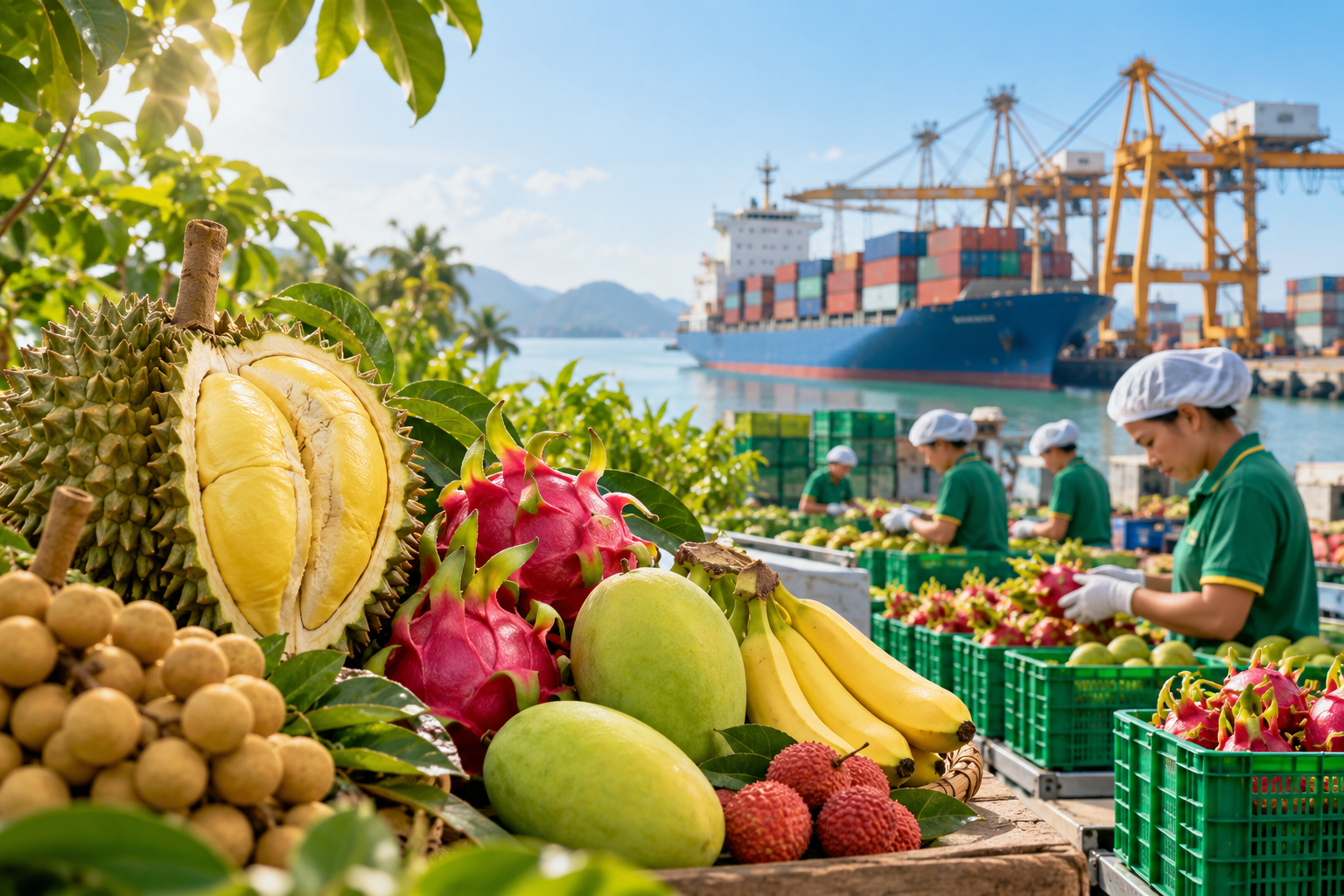
Export turnover for fruits and vegetables exceeded USD 6 billion in the first 8 months, up nearly 25% year-on-year, continuing to outpace the overall growth of agricultural exports. Durian, coconut, pomelo, and processed products are expanding into new markets, making fruits and vegetables a bright new spot in agricultural exports.
Market Expansion: Durian Leads the Surge
According to the Ministry of Agriculture and Environment, fruit and vegetable exports reached over USD 6 billion in the first 8 months of 2026, representing a nearly 25% increase compared to the same period last year. August alone was estimated at nearly USD 1.3 billion, building on July’s momentum when export turnover crossed the USD 1 billion mark for the first time. At this current pace, the sector is steadily advancing toward its goal of USD 9–10 billion for 2026.
Notably, this growth momentum is driven not only by volume expansion but also by a strategic shift in market demand. China remains the largest market, accounting for 58.9% of Vietnam’s total fruit and vegetable export value. Over the 7-month period, exports to China reached nearly USD 3 billion (up 33%), while exports to the United States exceeded USD 361 million (up 14.3%).
Durian continues to lead the pack. In the first 7 months, durian exports reached nearly USD 1.5 billion, surging by over 44%. China alone accounted for more than 95% of this volume, equivalent to approximately USD 1.38 billion (up nearly 50%). Starting from July 2026, India officially permitted imports of fresh Vietnamese durian, unlocking another major consumer market for this product.
According to Mr. Nguyen Dinh Tung, Vice Chairman of the Vietnam Fruit and Vegetable Association (VINAFRUIT), recent market openings have created a critical foundation for growth. He highlighted pomelo as a product with massive potential due to its long shelf life and stable supply zones; deepening its penetration into the Chinese market could generate substantial additional value.
In practice, market doors continue to swing open. Vietnam’s first commercial shipment of pomelos arrived in Australia in April 2026, while Vietnam and China signed protocols on phytosanitary requirements for fresh pomelo and lime. The U.S. is also expected to announce import approvals for Vietnamese passion fruit this year, while Japan is currently reviewing access for pomelos.
Thus, the current competitive edge of the fruit and vegetable industry lies not just in a few multi-billion-dollar items, but in the simultaneous expansion of both its product portfolio and market reach. This marks a significant point of differentiation from many other agricultural commodities that remain reliant on a handful of markets or global price fluctuations.
However, heavy reliance on China remains a key factor to consider. With a market share near 60%, any shift in quarantine standards, testing protocols, traceability requirements, or consumer preferences in China can directly impact domestic businesses and produce prices. The General Administration of Customs of China (GACC) approving 18 additional testing laboratories in Vietnam—raising the total number of recognized facilities to 50—is seen as a positive sign that boosts food safety inspection capacity and mitigates congestion risks during peak seasons.
From Fresh Exports to a High-Value Processing Race
While durian drives export turnover, deep processing is paving a more sustainable growth pathway for the entire industry. According to the Department of Crop Production and Plant Protection, the share of processed products in fruit and vegetable exports rose from 29.33% in the first 4 months of 2025 to 35.82% during the same period in 2026. This shift allows businesses to reduce seasonality risks, extend shelf life, and capture higher product value.
This strategic direction is being actively pursued by many enterprises. Nafoods Group, which focuses primarily on processed fruit products, has set a 2026 revenue target of VND 3,000 billion (up 45% compared to 2025). The company aims to expand its market reach, invest in technology, and build integrated value chains from raw material zones to processing and distribution.
Market realities show immense headroom for growth. Using the same raw input, fresh products are constrained by shelf life, logistics costs, and harvest seasons. Conversely, concentrated juices, purees, dried fruits, frozen produce, and other processed goods can access wider markets and alleviate the pressure of immediate sales during peak harvest periods.
Following directions from the Ministry of Agriculture and Environment, the fruit and vegetable sector must not only boost yields but also transition aggressively toward green production, standardized material zones, higher processing ratios, and rigorous quality control from input sources. These measures are essential for achieving the USD 10 billion milestone, moving away from over-reliance on a few "golden seasons" of durian or key fresh fruits.
Mr. Nguyen Dinh Tung emphasized that the key priority is managing farming area codes and input materials more strictly. He likened a farming area code to the "land certificate" of a production site; in the event of an issue, authorities can trace and isolate the problem rather than letting an isolated incident disrupt the entire industry. Exporters must also enhance their testing capacity to prevent cargo bottlenecks during peak seasons.
Meanwhile, Mr. Nguyen Thanh Binh, Chairman of VINAFRUIT, pointed out several bottlenecks needing urgent resolution: complex procedures for granting and managing farming area codes and packing facilities, fragile linkages between farmers and enterprises, risks of code counterfeiting, and improper chemical use. According to him, these operational risks could lead directly to market loss if not effectively controlled.
Logistics poses another major challenge. Fresh fruit exporters are heavily dependent on transit times. Exporter Vina T&T noted that geopolitical instabilities and maritime disruptions can lengthen transit times to Europe or the U.S. East Coast by 10 to 15 days, raising costs and complicating shipments for short-shelf-life goods.
Therefore, opening new markets is necessary but not sufficient. The fruit and vegetable sector must simultaneously solve the challenges of raw material zones, production standards, logistics, deep processing, and branding. This integrated approach serves as the core foundation to reduce reliance on any single market.
On a positive note, Vietnam is beginning to establish products in distinct market segments. Examples include Ben Tre green-skin pomelos competing in the U.S. market based on premium quality rather than low price, and Vietnamese coconuts steadily expanding their market share in both the U.S. and China. Looking ahead, Vietnam can realistically aim to build national fruit brands rather than relying solely on individual corporate labels.
As of August 30, 2026, Vietnam had issued nearly 10,300 farming area codes and almost 1,900 packing facility codes for fresh fruit exports to China, the United States, Australia, New Zealand, South Korea, Japan, and other markets. This scale demonstrates significant improvements in the sector's trade infrastructure; however, maintaining stringent quality management will be the deciding factor in retaining long-term market access.
Fruits and vegetables are rapidly establishing themselves as the new "growth engine" of Vietnam's agricultural exports, backed by a nearly 25% surge over 8 months and ongoing market expansions. Nevertheless, the journey from USD 6 billion to USD 10 billion cannot rely solely on durian or raw volume growth. Long-term competitive advantages will belong to enterprises that control raw material regions, satisfy international standards, invest in deep processing, diversify export markets, and build strong brands. When these pieces fall into place, Vietnamese produce will not only see higher export volumes but also capture a much larger share of value along the global chain.
Source: https://thuongtruong.com.vn/