


Fruit and Vegetable Sector Eyes New Milestone
02/10/2026 - 15:13:20 0 Industry News
Riding the momentum of key commodity groups, expanding markets, and favorable supply conditions in the final months of the year, Vietnam’s fruit and vegetable sector stands on the verge of a breakthrough toward a new export turnover milestone.
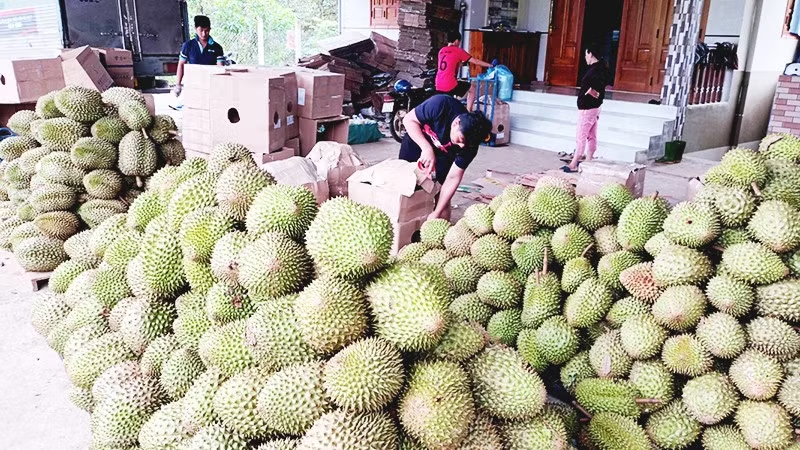
Durian continues to be a key driver of fruit and vegetable exports. Photo: Nguyet Anh
According to preliminary data from the General Department of Customs, fruit and vegetable exports in September 2026 reached more than $1.1 billion, a 15.1% decline compared to the same period in 2025. Nevertheless, this marks the third consecutive month in which fruit and vegetable export turnover crossed the $1 billion threshold, following July at approximately $1.12 billion and August at $1.37 billion. In the first nine months of the year, cumulative fruit and vegetable export turnover reached nearly $7.3 billion, an 18.5% increase year-on-year.
Raising Quality to Expand Markets
According to Mr. Dang Phuc Nguyen, Secretary-General of the Vietnam Fruit and Vegetable Association (VINAFRUIT), the sector's recent growth momentum stems from contributions across multiple product groups, including coconut, dragon fruit, passion fruit, and various processed fruit and vegetable products.
Durian continues to serve as a major engine for fruit and vegetable exports. The fruit has entered its peak harvest season amid sustained positive demand in China and several other markets. Supply shortages from Thailand and Malaysia at certain points have also unlocked additional opportunities for Vietnamese durians.
China currently accounts for nearly 58% of Vietnam’s total fruit and vegetable export turnover. Meanwhile, exports to the U.S. surged by 60% to $363 million; exports to Japan rose by 21%, the Netherlands by 39%, and Malaysia by 67%.
"These developments demonstrate that Vietnamese fruits and vegetables are progressively expanding their market footprint, thereby gradually reducing reliance on traditional markets," Mr. Nguyen noted.
From a business perspective, Mr. Nguyen Dinh Tung, CEO of Vina T&T Group (specializing in fruit exports), stated that market expansion places higher demands on product quality. Enterprises are increasing investments in raw material zones, preservation, packaging, and post-harvest treatment to meet the distinct requirements of each target market.
In mid-April 2026, Vina T&T Group exported its first shipment of Vinh Long green-skin pomelos to Australia. To enter this market, the company exercised strict control from planting areas and product traceability to preliminary processing, packaging, and post-harvest treatment to guarantee quality throughout transit.
For fresh coconuts, the company has focused on improving preservation techniques. Storage life has now been extended to approximately 70–80 days—a prerequisite enabling sea freight transportation to far-off markets.
"Investing in preservation, raw material source zones, and post-harvest processing gives businesses greater autonomy when fulfilling new orders. For fresh produce, maintaining rigorous control across these stages is essential to preserve quality during long-distance transit and meet the rising standards of foreign partners," Mr. Tung emphasized.
The export outlook for fruits and vegetables in the closing months of the year remains highly positive. According to the Import-Export Department under the Ministry of Industry and Trade, October marks the peak durian harvest in Dak Lak, Lam Dong, and Gia Lai provinces (as Thailand's summer durian season draws to a close). Durian alone is expected to contribute an additional $1.5–2 billion to export turnover in the final months of the year.
Beyond durian, demand for fruits and vegetables across many Asian markets typically escalates in the fourth quarter to serve holiday and New Year festivities. In China and Northeast Asia, demand for dragon fruit, fresh coconut, pomelo, and various other tropical fruits is anticipated to remain strong.
Dried products, quick-frozen (IQF) goods, and juices currently account for more than 30% of total fruit and vegetable export turnover. This segment helps enterprises utilize raw materials during peak harvest periods while extending shelf life and boosting product value.
Sustaining Growth Momentum
The fruit and vegetable sector stands before an opportunity to reach the $10 billion milestone this year. The remaining gap can be bridged in the fourth quarter if durian supplies, market demand, and orders across major product groups remain favorable. Monthly export revenues exceeding $1 billion over the past three months also highlight the headroom for the industry to accelerate further.
However, the sector still faces constraints regarding product quality, uniformity ratios, and prohibited chemical residues in certain items. Product traceability systems remain incomplete, while shortcomings persist in issuing and managing plant area codes, packing facility codes, testing, inspection, and certification—impacting export progress and efficiency.
Importing markets, including China, are increasingly tightening controls over pesticide residues, plant area codes, packing facility codes, and traceability. These factors can directly affect customs clearance speed and the maintenance of enterprise orders.
According to a representative from VINAFRUIT, businesses need to enforce stricter quality control and traceability while increasing the proportion of processed products to ensure stable exports. Shifting from volume expansion to quality enhancement is becoming vital as Vietnamese fruits and vegetables venture into high-standard markets like the U.S., Japan, South Korea, and Europe. From a market perspective, processed products also help relieve consumption pressure when various fruits hit peak harvest simultaneously. Instead of relying entirely on fresh exports, enterprises can process raw materials to extend product life cycles and add value.
On the regulatory side, the Ministry of Industry and Trade has identified market diversification, effective utilization of Free Trade Agreements (FTAs), and enhanced trade promotion as core solutions for 2026. The Ministry will continue to closely monitor market developments and import policies to provide timely information, early warnings, and support for businesses to proactively adjust export plans.
For fruits and vegetables, expanding outlets goes hand-in-hand with strengthening direct connections between Vietnamese enterprises and overseas importers and distribution networks. Vietnam’s Trade Offices abroad have been tasked with stepping up partner matching, providing market intelligence, and assisting businesses in tapping new distribution channels. In China specifically, the Ministry of Industry and Trade has rolled out business matching programs connecting enterprises with importers and distribution systems across multiple localities.
In parallel with market expansion, the Ministry of Industry and Trade is prioritizing early warnings on trade barriers, traceability mandates, and import standards to help enterprises better prepare before shipping goods. The Ministry is also coordinating with relevant authorities to oversee quality control, quarantine, and technical compliance for exported agricultural products, mitigating risks of warnings, rejections, or import suspensions.
For fresh produce like fruits and vegetables, transport costs and transit times directly impact competitiveness. Consequently, enhancing logistics efficiency, strengthening supply chain linkages, and facilitating trade remain key support measures set by the Ministry of Industry and Trade. This foundation will enable enterprises to cut costs, minimize transit risks, and better fulfill orders in long-distance markets.
Thus, alongside quality improvement and raw material zone reorganization, the roadmap for the fruit and vegetable sector in the coming period centers on expanding markets, penetrating deeper into distribution channels, and driving value rather than merely increasing output volume. This serves as the cornerstone for the industry to draw closer to its $10 billion target while creating momentum for sustained growth in the years ahead.
Source: https://nhandan.vn