


Unlocking Export Growth for Agricultural, Forestry, and Fishery Products
21/09/2026 - 17:11:16 1 Industry News
From now through the end of 2026, the task for the Ministry of Agriculture and Environment is not simply to increase export turnover, but also to maintain momentum in major markets, unlock the potential of promising product groups, and quickly address bottlenecks related to standards, logistics, and raw materials.
Maintaining Major Markets, Expanding Growth Potential
According to the Ministry of Agriculture and Environment (MARD), agricultural, forestry, and fishery exports reached US$49.3 billion in the first eight months of the year. Of this, agricultural products accounted for US$25.66 billion; forestry products US$12.57 billion; seafood US$7.94 billion; and livestock products US$511.9 million. Notably, seafood exports increased by 10.9%, livestock products by 30%, while forestry products rose 5.4%.
The market structure continues to highlight Asia's prominent role. Exports to China reached US$11.2 billion, up 22.1%; the United States reached US$9.4 billion, down 0.4%; and Japan reached US$3.3 billion, up 2%. China currently accounts for 22.7% of Vietnam's agricultural, forestry, and fishery export market share.
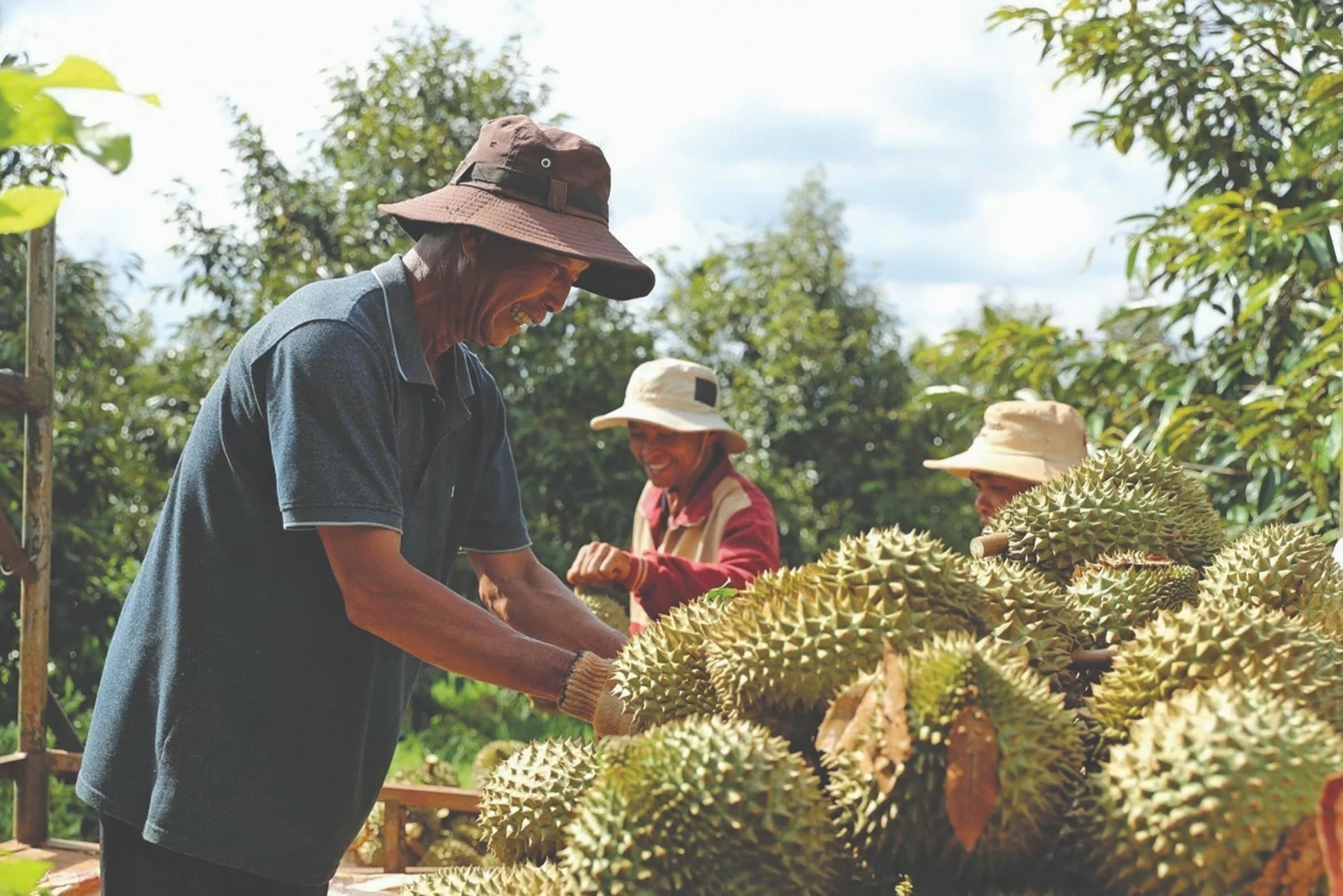
Vietnam's durian exports aim to reach US$4 billion in 2026. Photo: Duc Thanh
Deputy Minister of Agriculture and Environment Dang Ngoc Diep said that during the final four months of the year, the ministry will continue to closely monitor individual markets and product groups, while removing technical barriers, accelerating the issuance of growing-area codes and packing-facility codes, and completing traceability requirements. These measures are critical as importing markets continue to raise their standards.
According to Ngo Xuan Nam, Deputy Director of the Vietnam SPS Office, from the beginning of the year through September 15, China, Europe, and the Middle East-Africa region had issued 254 sanitary and phytosanitary (SPS) measures, referring to regulations and procedures on plant and animal quarantine and food safety aimed at protecting human, animal, and plant health. The new requirements directly concern residue limits, active substances, quarantine, facility registration, and traceability.
Therefore, market expansion cannot be separated from raising production standards. Businesses and raw material production areas need to understand market requirements before organizing production, rather than waiting until goods reach the border gate to address compliance issues.
Alongside maintaining traditional markets, the agricultural sector is also targeting the Middle East, Africa, Latin America, and several potential markets to diversify risks and create additional outlets for competitive product groups.
Durian Needs More "Doors" to Accelerate Growth
Durian is currently one of the product groups with significant potential to generate additional value in the final months of the year.
According to Deputy Minister Dang Ngoc Diep, Vietnam currently has around 200,000 hectares of durian, with output of approximately 2.08 million tonnes. In 2021, durian exports were only around US$177 million. By 2025, export turnover had risen to US$3.85 billion. In the first eight months of 2026, durian exports are estimated at around US$1.95 billion. Of this, China accounted for approximately US$1.85 billion, or around 95%.
This growth trajectory demonstrates the appeal of Vietnamese durian, but also highlights the need to reduce dependence on a single market. The Ministry of Agriculture and Environment has worked with localities with large growing areas in the Central Highlands, Southeast, and Mekong Delta regions to address outstanding difficulties.
One notable result is that China's General Administration of Customs has approved an additional 567 growing-area codes for Vietnamese durian, bringing the total to more than 1,800.
At the same time, the process for issuing growing-area codes has been streamlined. From August 1, 2026, processing time was reduced from 10 days to three days. This administrative reform is intended to provide timely support for products facing strong market demand, such as durian.
However, expanding growing-area codes alone will not be enough for durian to continue contributing to export growth. The sector needs to reorganize raw material areas and link production with preliminary processing, processing, storage, and distribution. Frozen durian exports and processed products have also been identified as avenues for increasing value and reducing pressure from dependence on fresh fruit. The Ministry of Agriculture and Environment is also targeting market expansion into India, Australia, and New Zealand.
The ministry's target is for durian exports in 2026 to reach at least the 2025 level of US$3.85 billion, with a goal of around US$4 billion.
Rice Under Pressure, Seafood Still Has Growth Potential
Seafood has been a bright spot in the first eight months of 2026, with export turnover reaching US$7.94 billion, up 10.9%. It is one of the fastest-growing product groups within Vietnam's agricultural, forestry, and fishery export structure.
The Vietnam Association of Seafood Exporters and Producers (VASEP) forecasts that full-year seafood exports could reach US$12.3–12.5 billion if bottlenecks related to raw materials and logistics are resolved.
The association has proposed reducing transportation costs and developing a fleet of refrigerated container vessels to reduce dependence on foreign shipping lines. This is also a common challenge across many product groups: strong production performance alone is not enough; goods must also reach markets at competitive costs.
Not all product groups are growing at the same pace. Rice is one example. Data for the first eight months show that Vietnam exported approximately 6 million tonnes of rice worth US$2.86 billion, down 6.3% in volume and 11.9% in value year-on-year. The Philippines remained the largest market, accounting for 43.2% of market share; China accounted for 18.4% and Ghana 11%. Notably, rice exports to China increased by 92.2%, while export value to the Philippines declined by 5.1%. These developments show that the rice sector's potential lies not only in volume.
Mr. Do Ha Nam, Chairman of the Vietnam Food Association, said the target of exporting 8 million tonnes of rice in 2026 is achievable. However, he proposed strengthening dialogue with major markets such as the Philippines to address barriers arising from new policies, while providing credit support and investing in post-harvest storage facilities.
Final Four Months: Removing Bottlenecks to Accelerate GrowthTo achieve the US$74 billion export target, the agricultural sector needs to generate approximately US$24.9 billion in the final four months of the year, equivalent to an average of US$6.23 billion per month. Rather than distributing the pressure evenly across all product groups, the sector needs to closely monitor growth scenarios for each field and product, while regularly updating output, value, and market developments to enable flexible management. For exports, the Ministry of Agriculture and Environment is focusing on three groups of solutions.
First is maintaining markets and removing barriers. Technical alerts, SPS regulations, traceability requirements, growing-area codes, and packing-facility codes must be updated promptly so that businesses have sufficient time to adjust production.
The second is unlocking the capacity of individual product groups. For durian, the priorities are growing-area codes, processing, and market diversification. For rice, they are markets, storage facilities, and credit. For seafood, they are raw materials, logistics, and addressing requirements related to IUU fishing.
The ministry will continue to reduce costs and accelerate administrative procedures. Reducing the processing time for growing-area codes from 10 days to three days demonstrates that administrative reform can have a direct impact on the ability to capture market opportunities.
The ministry will address bottlenecks related to land, water resources, and the environment, while promoting science and technology, innovation, and digital transformation.
From durian to rice and seafood, each product group faces different bottlenecks. To accelerate exports, solutions must therefore be designed for each market and each product. This is how the US$74 billion target can be pursued not simply through a final sprint in export turnover, but by opening new markets, increasing the value of individual products, and quickly removing the bottlenecks standing in the way of Vietnamese agricultural products reaching global markets.
Source https://thoibaotaichinhvietnam.vn/