


Vietnamese Agricultural and Forestry Products: Strengthening Position in Global Value Chains
23/09/2026 - 16:54:03 2 Industry News
Wood, coffee, and rubber have established a significant export position, but the share of value retained by Vietnam in global value chains still needs to be improved. The challenge is to shift from producing according to requirements to taking greater control over products, standards, data, and brands.
This was the focus of the online seminar "From Compliance to Leading Global Agricultural and Forestry Value Chains: Vietnam's Current Situation and Future Opportunities," held on the afternoon of September 22 and organized by the Agricultural and Forestry Policy Research Network.
Speaking at the seminar, Nguyen Quoc Khanh, Chairman of the Vietnam Timber and Forest Products Association (VIFOREST) and Chairman of the Board of Directors of AA Corporation, said Vietnam's exports of wood, furniture, and handicrafts had risen from around US300 million 20 years ago to US17.2 billion in 2025, generating a trade surplus of nearly US$12 billion.
Vietnam has developed a relatively comprehensive supply chain, from forest planting and raw materials to processing, design, manufacturing, and logistics, creating jobs for around 1 million workers. However, large production capacity does not necessarily translate into the ability to shape the market.
Most businesses still manufacture according to designs and requirements from partners under the original equipment manufacturing (OEM) model, while original design manufacturing (ODM) and original brand manufacturing (OBM), which allow deeper participation in product design, development, and brand building, remain uncommon.
According to Mr. Khanh, the wood industry needs to invest more heavily in design, branding, sustainability, transparency, and traceability, while shifting from responding to requirements toward anticipating market demand. Early identification of changes in consumer preferences, technology, and standards will enable businesses to prepare in advance rather than simply respond once requirements become mandatory.
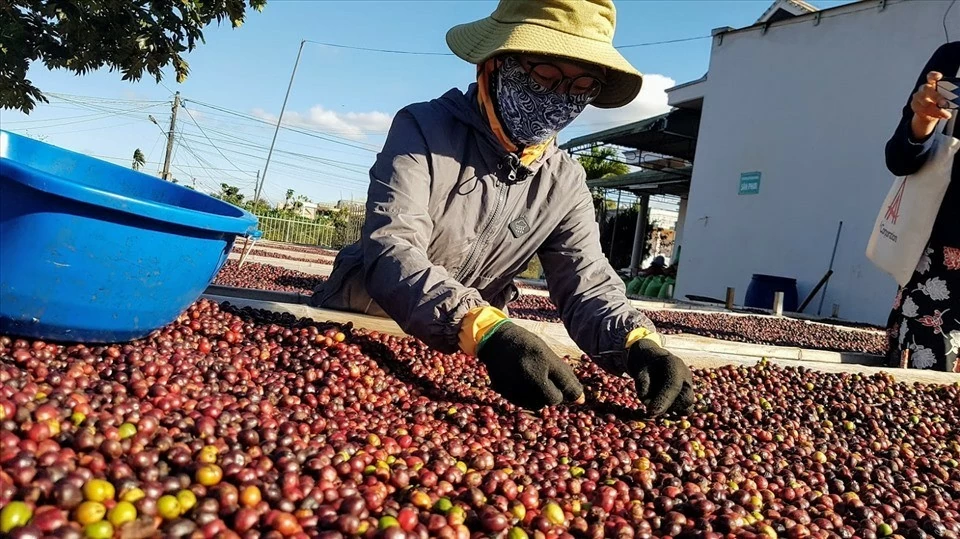
Vietnam's coffee industry expects to achieve US$9 billion in export turnover in 2026. Photo: Vu Long.
For coffee, the key bottleneck is converting production advantages, particularly in robusta, into higher value. Thai Nhu Hiep, Vice Chairman of the Vietnam Coffee and Cocoa Association and Chairman of Vinh Hiep Co., Ltd., said the industry needs to take greater control of quality, data, traceability, and standards related to sustainability and emissions reduction, rather than simply producing and then seeking markets.
Stronger linkages among businesses are also needed to establish common standards and data systems. When these elements are managed throughout the process, from raw material areas to markets, international standards can become a bargaining advantage and strengthen the industry's position.
For rubber, the bottleneck lies in the product structure. According to Nguyen Viet Tuong, former Vice Chairman of the Vietnam Rubber Association, Vietnam ranks fourth globally in natural rubber production and third in exports, but continues to export mainly natural rubber, while deep processing, technical rubber, and value-added products remain limited. The industry needs to shift from pursuing volume to increasing value, while accelerating technological development, deep processing, standards, traceability, and branding.
At the seminar, delegates agreed that Vietnamese businesses currently remain heavily focused on production, processing, and exports, while standards, market requirements, regulations, and business models are often shaped externally. The challenge is to move from merely complying with the rules of the game to actively participating in shaping value chains.
To achieve this, businesses need to invest in technology, product development, branding, and data management capabilities. Industry associations need to strengthen their role in connectivity, information provision, market forecasting, and industry representation, while regulators need to create an appropriate policy, standards, and data infrastructure environment.
In this context, data on raw material areas, output, quality, traceability, emissions, and markets is becoming increasingly important. It is not merely a management tool, but also determines the ability to meet buyer requirements and access higher-value market segments.
To Mr. Xuan Phuc, Executive Director of Forest Trends, said Vietnam needs to move from being a production and supply base to becoming a trusted partner in global value chains. Traceability, supply chain transparency, standards, and data should be viewed not only as compliance requirements but also as foundations for building trust and expanding participation in higher-value segments.Therefore, the goal of exports should not simply be for the world to know what Vietnam can produce, but more importantly, to trust that Vietnam has the capacity to jointly develop and create value throughout the value chain.
Source: https://thoibaotaichinhvietnam.vn/